Fashion advertising shifted dramatically once celebrities stepped into roles that once belonged only to models.
Influence moved into a space where personality, cultural timing, and visual experimentation shaped how audiences responded.
The campaigns we decided to speak about today reveal different methods of disruption, each approached through a distinct editorial angle.
Let’s check them out.
1. Kate Moss for Calvin Klein (1992)
View this post on Instagram
A studio in 1992 carried an unsettling stillness before Patrick Demarchelier began shooting.
Assistants moved quietly, unsure of what kind of image might emerge once Moss stepped into the light.
Moss arrived with:
- No elaborate makeup
- No sculpted hair
- No fashion armor
A late phone call had brought her into the job, replacing a polished star with a young face that carried none of the era’s expected glamour.
Her presence unsettled the crew at first, not out of concern, but out of curiosity for what such stark simplicity might produce.
A shift occurred as soon as Moss relaxed into her pose. Lines softened, gestures lost self-consciousness, and the room recognized a new kind of power building in the frame. Light touched her features in a way that exposed vulnerability, sparseness, and honesty.
Fashion writing later described the moment as a turning point for minimalism, yet the atmosphere inside the studio felt far less strategic. A quiet clarity had surfaced, and everyone sensed it.
A decade went on to absorb those images as proof that understated presentation could challenge grandeur.
Moss’s appearance carved a place for rawness in commercial photography, influencing stylists, editors, and designers who once believed only high drama could sell clothing.
Countless brands referenced those frames as inspiration for campaigns that favored emotion over polish.
Ultimately, she walked out unaware that cultural impact had already begun shaping itself around her.
2. Madonna for Versace (A/W 1995)
View this post on Instagram
Madonna entered Mario Testino’s studio prepared for a reinvention that felt controlled rather than chaotic.
Past public imagery leaned on heat, shock, and spectacle, yet her demeanor that day carried a slow confidence.
Soft fabrics replaced aggressive styling, and a warm palette muted the persona most audiences expected.
Testino directed with quiet precision, encouraging her to lean into stillness instead of performance.
An unexpected calm settled into the shots. Madonna’s expressions no longer competed with fashion but worked in sync with it. Critics later responded to the campaign as if examining a portrait of a woman rewriting her narrative with intention.
Many noted how she chose restraint as a tool rather than relying on provocation.
Recognition by the National Portrait Gallery confirmed the campaign’s cultural reach, signaling that fashion photography had entered a space once reserved for traditional portraiture.
Reinvention became a methodical craft, shaped by collaboration rather than reaction.
Madonna’s decision to present new softness marked a decisive shift in celebrity control over personal branding.
3. Sharon Stone for Mugler Capsule (2024)
View this post on Instagram
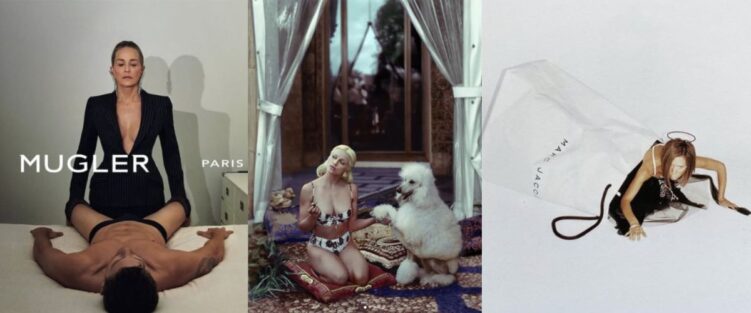
Sharon Stone appeared in Mugler’s 2024 capsule collection with a presence sharpened by decades of cinematic and cultural weight.
On set, she navigated the structured pieces, corseted silhouettes, sculptural jackets, futuristic bodysuits, with a calm precision that didn’t echo the past but reframed it. These were not reenactments.
The tailoring, once associated with 90s defiance, felt reconsidered in her hands, less about rebellion, more about self-possession.
Observers on set described how nothing felt overstated. Her posture did the work. There was no mimicry of earlier campaigns, no attempt to chase a previous moment.
WWD highlighted this quality, noting her hypnotic effect and the clarity she brought to every shot. Her presence altered the conversation around the garments themselves, shifting focus toward what it means to carry history forward rather than simply reference it.
Amid this, a quiet mention belongs to photographer Eric Michael Roy, who has worked with Stone on several unrelated projects.
Known for his collaboration with Gravity Backdrops, a company that crafts hand-painted photography backdrops, Roy has captured her in more intimate settings, often emphasizing subtle power over spectacle.
4. Sophie Dahl for YSL Opium (2000)
View this post on Instagram
Public attention erupted almost instantly once Sophie Dahl appeared in her reclining pose for YSL Opium. Steven Meisel and Tom Ford created a vision aimed at provoking desire, but the response reached far past admiration.
Streets are filled with billboards displaying Dahl in an ecstatic posture, sparking intense reactions across households, offices, and public institutions.
Complaints poured into regulatory boards, eventually leading to a ban in the UK.
Critics entered the debate with sharp disagreement. Some praised the ad for embracing sensuality without hesitation, while others drew connections to historical portrayals of women depicted in passive, vulnerable positions.
Feminist writers pointed to imagery reminiscent of figures staged for male consumption. Supporters argued that Dahl carried agency, presence, and intention in her pose.
Opponents insisted the framing created inadvertent symbolism that overshadowed any message tied to fragrance.
Marketing teams rarely anticipate such a scale of reaction.
Yet the uproar placed Opium at the center of discussions about eroticism, artistic risk, and responsibility within visual culture.
No perfume campaign in recent memory had forced audiences to consider how desire is constructed, displayed, and sold.
5. Rihanna for Fenty x Puma (2016)
Rihanna approached her collaboration with Puma with a designer’s mindset rather than a spokesperson’s duties.
Meetings involved fabric selection, construction choices, and proportion adjustments. Team members spoke about her sharp instinct for balancing streetwear influence with sculptural form.
Footwear pieces such as faux-fur slides were not accidents of trend forecasting but deliberate expressions of her style.
A shift occurred across the industry as soon as early images surfaced.
Celebrities had participated in fashion campaigns before, yet Rihanna’s involvement operated at another level. She shaped mood boards, gave direction during fittings, and defined the attitude of each campaign photo.
Marie Claire noted the fierce presence she brought to the visuals, yet insiders argued her creative contributions mattered far more than her pose.
Retail response confirmed that audiences recognized her authorship.
A new model for celebrity-brand partnerships emerged, driven by contribution rather than endorsement.
Rihanna continues to shape fashion through her Fenty x Puma partnership, returning with a compact collection anchored in bold color and sport-inspired design.
At the March 12, 2025, launch, she wore the Avanti LS in slime green and styled her look with layers that balanced athletic elements and playful textures:
- Neon green bikini top by Heavy Manners
- Sheer mesh dress with a two-tone ruffled skirt
- Patchwork baseball jersey for added coverage
- Chrome statement necklace by Sabyasachi
6. Victoria Beckham for Marc Jacobs (S/S 2008)
View this post on Instagram
Juergen Teller constructed a world that felt both humorous and critical, using Beckham as the central figure in a visual satire of consumption and celebrity.
Crew members laughed in disbelief as her legs emerged awkwardly from a massive shopping bag, creating an image that mocked the very system she had been scrutinized by for years.
Beckham approached the set with confidence, understanding that self-parody could dismantle stereotypes more effectively than confrontation.
Another described the crab-like pose that turned her into an object intentionally rather than through tabloids. Humor granted her agency.
By leaning into exaggeration, she rewrote the conversation. Editors who once doubted her place in high fashion began reassessing her potential as a designer.
Marc Jacobs benefited from the unexpected twist.
A campaign that risked alienating audiences instead caught attention for its wit. Beckham’s willingness to participate in satire accelerated her shift toward a respected fashion figure.
7. Cara Delevingne for Saint Laurent (2016)
Cara Delevingne’s return created anticipation across fashion outlets. Many assumed acting had claimed her attention permanently, yet Hedi Slimane invited her back with full confidence.
Slimane’s relationship with Delevingne had always centered on personality and artistic tool. Her energy, mischief, and sharp expressions brought movement into still frames.
Once shooting began, it became clear that Delevingne had not lost the instincts that elevated her earlier campaigns.
Angles amplified her bold presence, and clothing gained attitude simply by being in her orbit.
Saint Laurent’s rock-infused identity thrived on rebellion, and Delevingne embodied that energy without forcing it.
Fans saw the campaign as a marker of return, though Slimane treated it more as a continuation of a shared creative dialogue.
Industry voices noted how charisma often carries more weight than celebrity status.
Delevingne delivered exactly that, turning the campaign into a character study rather than a fashion showcase.
8. Nicola Coughlan for Skims (2024)
@nicolacoughlan Everybody’s wearing @SKIMS ♬ original sound – nicolacoughlan
Nicola Coughlan stepped onto Vanessa Beecroft’s set, styled like a portrait subject from a Renaissance workshop.
Draped fabric, sculptural poses, and soft lighting shaped an atmosphere that echoed classical art without attempting imitation.
Coughlan brought calm strength into each shot, creating an image that refused distortion or concealment.
Media conversation centered on the casting choice. Audiences rarely saw a figure outside sample sizing depicted with such reverence in campaigns tied to luxury-adjacent fashion.
Writers emphasized how striking it felt to watch contemporary culture embrace references associated with European classical beauty while expanding who could embody that imagery.
Beecroft’s composition carried quiet intention. Bodies of all types had appeared in Skims campaigns, yet Coughlan’s presence marked a definitive cultural shift.
Pop culture responded instantly, citing her role as evidence that broader visibility had entered mainstream fashion marketing with sincerity rather than tokenism.
Summary
Campaigns across these three decades reveal strategies shaped by storytelling rather than pure promotion.
Stars reimagined themselves, stirred controversy, expanded creative roles, or challenged visual norms.
Influence shifted into a place where personality shaped branding as strongly as design.
Fashion marketing now follows a model centered on collaboration, point of view, and cultural presence.